> For the complete documentation index, see [llms.txt](https://docs.amesa.com/llms.txt). Markdown versions of documentation pages are available by appending `.md` to page URLs; this page is available as [Markdown](https://docs.amesa.com/tutorials/industrial-mixer/getting-started.md).
# Get Started
This getting started guide takes you through the steps you will need to go through before you can start building your teams of agents.
## Prerequisites
* A AMESA account
## Create Your Use Case
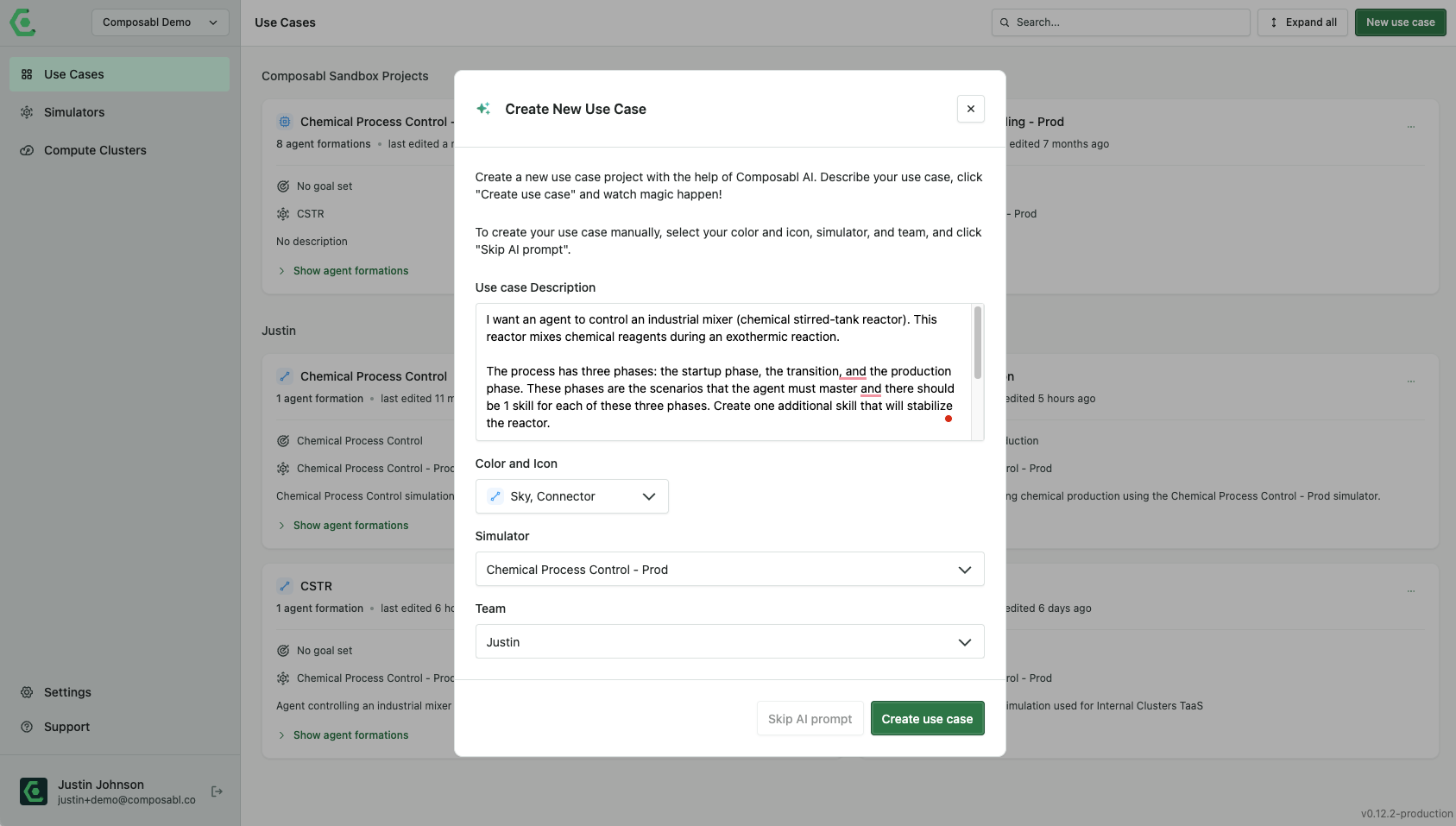
The first thing you will do is [create your use case](https://docs.amesa.com/build-autonomous-agents/create-a-project) in the AMESA UI.
Select the simulator you will use for the project and the assigned team. If you haven't created a team yet, you will need to do that before you create your first project.
Then, you can use the AI prompt to explain what you are attempting to achieve with your project and have it bootstrap based on your description. I will describe the use case skills, goals, and constraints and call it Chemical Process Control.
Click `New use case` and `Create use case`
## Set Use Case Goals
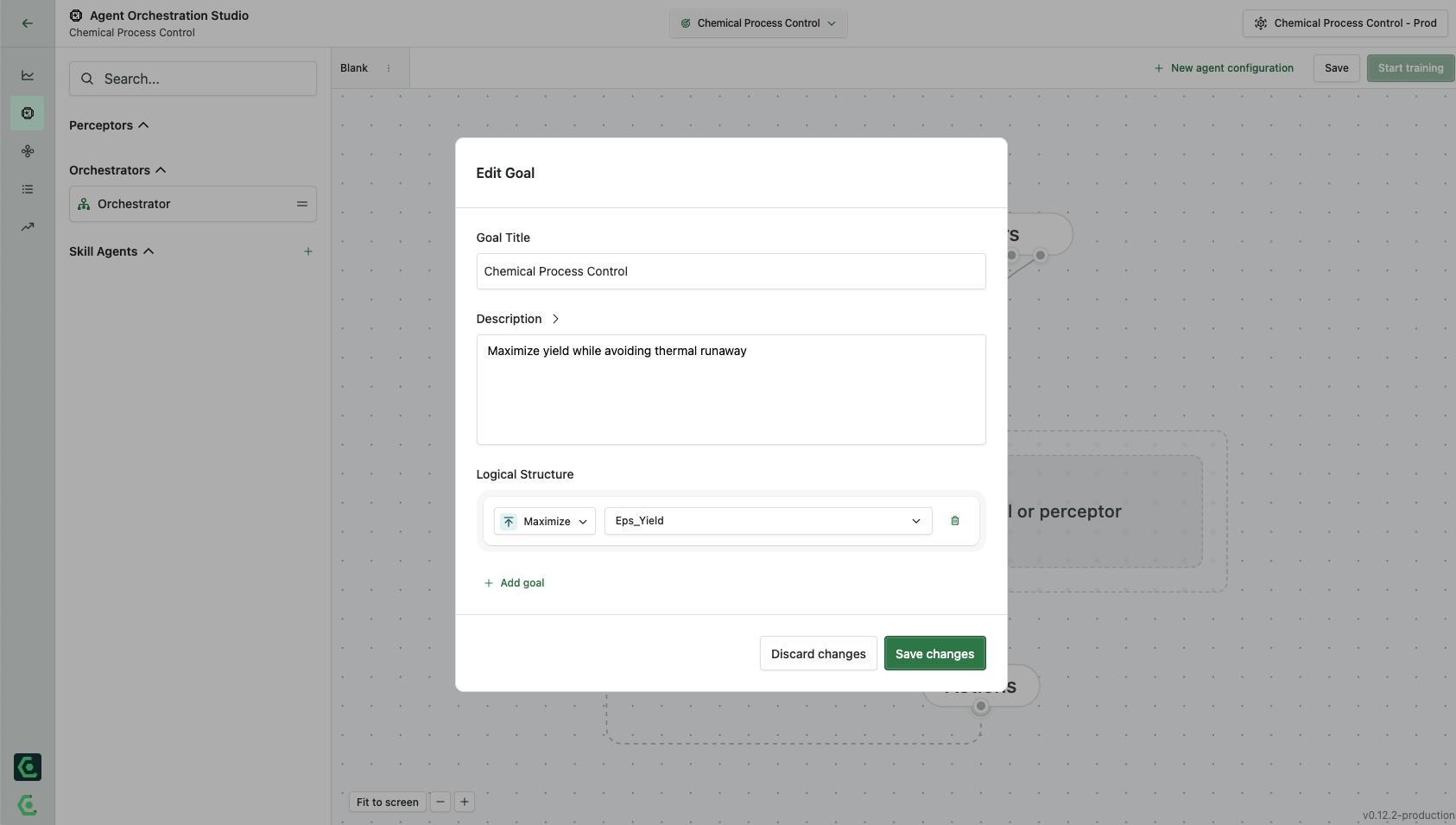
To finish setting up your use case, set your top-level project goal.
Now, we will set the goal for this example. In this project, we want to:
* Maximize yield (make as much product as we can)
### Goal Title and Description
Fill out the goal title and description for the top-level goal.
**Goal Title**: Chemical Process Control Goals
**Description**: The goal for this project is to maximize yield
### Logical Structure
We are going to one condition to represent our goal.
1. To maximize yield, the objective is `Maximize` , and the variable is `Eps_Yield`
Now you can save your changes.
**Now that you have created your new use case and set the goal, you can start creating agent systems!**
## Optional: Set Up the Data Science Workflow
Some of the steps in this tutorial use AMESA's data science workflow, which allows data scientists and controls engineers to publish any Python module to the AMESA platform to use in multi-agent systems.
To use this workflow, complete these steps:
* [Install the AMESA CLI](https://docs.amesa.com/get-started/access-amesa#installing-the-sdk)
* [Clone the Industrial Mixer Repo](https://github.com/AMESA/industrial-mixer-tutorial)
**Now that you have your project created and your goals set you're ready to start creating agents!**
---
# Agent Instructions
This documentation is published with GitBook. GitBook is the documentation platform designed so that both humans and AI agents can read, navigate, and reason over technical content effectively. Learn more at gitbook.com.
## Querying This Documentation
If you need additional information that is not directly available in this page, you can query the documentation by asking a question.
Perform an HTTP GET request on the following URL with the `ask` and `goal` query parameters:
```
GET https://docs.amesa.com/tutorials/industrial-mixer/getting-started.md?ask=&goal=
```
`ask` is the immediate question: it should be specific, self-contained, and written in natural language.
`goal` is what the user is ultimately trying to achieve, the reason they need the answer. Sharing it helps GitBook give you a better, more relevant answer. A goal is most helpful when it describes the outcome the user wants rather than restating the question. For example, with `ask=how do I create an API token`, a goal like `automate deployments from our CI pipeline` lets GitBook tailor the answer to that use case.
The response will contain a direct answer to the question and relevant excerpts and sources from the documentation.
Use this mechanism when the answer is not explicitly present in the current page, you need clarification or additional context, or you want to retrieve related documentation sections.